A Teachers Course on Writing and
Culture
I'm a little hesitant about talking on
teaching composition to all of you who do more teaching of it than I ever do. But Mrs. Thoburn felt that I should
speak on this subject.
As a professional writer I do have
some ideas on the subject. And, perhaps, some of the things I say may be relevant to you in your work as
teachers.
First of all, teaching composition
simply means, "teaching good writing." It's as simple as that.
Second, we must say that good writing is
clear thinking. Muddled thinking and muddled writing is a headache in any and every area. In fact, one of the
problems of our day is that, as at the end of every age, thinking is muddled and therefore writing is muddled. It's
a curious, but very significant fact.
But in the days before the fall of
Greece there was no good writing and no good thinking. Before the fall of Rome there was no good writing and no
good thinking. As the medieval era came to a close, again, there was no good thinking and no good writing. We have
the same problem today. Good writing is clear thinking.
This is why in a Christian school you
can teach good writing in a way that you cannot in a state school. The whole philosophy of humanistic man is such,
today, that it militates against clear thinking and therefore good writing.
Examples of Muddled Writing
Look at the major magazines in the
country today. When I pick up, for example, a copy of a National Review I find it infuriating reading. The style is
so bad. The points are made in such a peculiar and involved way. These are conservative writers. I find myself
usually in somewhat of an agreeable position to what they have to say. But I very often simply throw the magazine
aside and refuse to go ahead any further because I find that it's too irritating, too aggravating to me to read
that kind of muddled writing.
I read Harpers and the Atlantic Monthly.
These two periodicals are supposed to represent the best in American literary standards. They are, definitely,
superior to much else. And yet, here again, we have this same problem. More than once I've gone to my wife with a
paragraph and I have thrust it in front of her and I've said, "Read it and tell me if it makes any sense to you."
And she has to agree with me that somehow there isn't a coherent and a consistent point made.
At the end of every age there is a
collapse of culture, a collapse of thinking and it reflects itself in the writing. This is why I think composition
can only be properly taught in this day and age in a Christian school; precisely because the Christian school, in
my opinion, represents the wave of the future. It represents that agency which, alone, is teaching the consistently
good leadership for tomorrow; only there can you teach good composition.
Bad Writing in Colleges
I do a great deal of lecturing on
secular college and university campuses and, once in a while, as this week, at a Christian college campus. On some
of these secular university campuses I have had occasion at times to see some of the papers that some of the
students are doing and the superior grades they get for them. And it is appalling to see the kind of garbage that
is turned in. And I mean garbage in terms of any kind of literary standard.
The inability to think straight, and
then to express that, is one that is more and more apparent in our culture. We must say, further, that the purpose
of good punctuation and good grammar is simply to further clear thinking. This is the emphasis we must make when we
teach grammar and punctuation.
I had the usual problems that children
do with grammar and punctuation. I think I was better than most. I was getting A's. But it wasn't until I
encountered a teacher who simply explained what each punctuation mark did and what the rules of grammar did for
clear thinking that suddenly the purpose of it all came home to me and I never forgot, thereafter, the rules so
that when you explain the rules of punctuation and of grammar, emphasize their function in teaching clear
thinking.
False Syllogisms
The structure of a paragraph: It's a
body of thought. It is not a false syllogism. It is important, therefore, in teaching good composition to stress
thinking in the composition and the content thereof so that besides being grammatically correct and correct as far
as punctuation is concerned, it is clear, logical thinking; that it does not involve false syllogisms.
Now, in case you don't know what a false
syllogism is, it's a proposition which is seemingly logical but which leads to an illogical conclusion because the
various aspects of it are improperly phrased, involve too much and therefore lead to false conclusions.
I can illustrate with this:
A. Man is a two-legged animal.
B. A chicken is a two-legged animal.
C. It follows, therefore, that a chicken
is a man.
Now, that's a false syllogism. You have
begun by defining man in terms of being a two-legged animal, which is true. Man is a two-legged animal. But he is
more than a two-legged animal. And your definition, thus, leads to a false conclusion.
Now, this is important because so much
of our writing, so much of the argument you hear nowadays in politics, on television talk shows, magazine articles,
involves this kind of illogical thinking; false syllogisms. That's why it is important to stress this kind of
thinking, clear headed, avoiding false syllogisms with the child.
Thinking Before Writing
A paragraph is a logical, consistent
body of thought. And thought must precede writing always. Thought must precede writing.
It's important, therefore, to think
something out before it is written. When I sit down to write, for example, I have been dealing with a subject for
some time so that when I go over a chapter that I have written for any one of my books-I write in long hand-on rare
occasions I may make a correction. Very often my chapters will appear exactly as I wrote them in the book. The
reason, of course, is I have thought the subject through backwards and forwards so that when I sit down to write
it's just a question of letting it flow.
You can have logical writing, good
writing, when you have given as much time as possible to thinking beforehand. And this is why it is important for
children to be taught they must think before they write.
I had a teacher once who tried a novel
experiment with us. Everyone in the class was to get up and give a five-minute talk. That talk was criticized and
then we were to write it. The whole point was to see how our writing reflected the thinking of the oral
composition-and we'll come back to that subsequently-in terms of the criticism of the kind of argument we had used.
The point was to improve our thinking before we came to writing. It was a very healthy exercise especially because
the class was encouraged to be ruthless with everyone who was up in front talking. They took to that very quickly.
And it was good discipline.
"Propositional Truth"
Next, a very important point; one which
is never stressed nowadays: the question of propositional truth. A few of you may be familiar with this subject
because there are some who deny that the Bible gives us propositional truth. But what we must say is that all
language is propositional. All language is propositional. Every word involves a proposition concerning reality.
Take, for example, the word "sovereign."
The word "sovereign" properly belongs to God: ultimate, absolute, final, Lord over all things. When men begin to
use the word "sovereign" for the state or for state's rights or for man, they have thereby made man or an
institution of man into God.
The word "is" is propositional. The word
"is" says there is being, present being. That's a proposition.
All language is inescapably
propositional. As a result we must say the emphasis in modern writing, modern composition, modern literature on
mood writing is utterly ridiculous. It is false. You cannot even convey a mood without, first of all, having a
proposition.
As a result, it is very, very helpful to
stress the use of a dictionary, a very precise emphasis on definitions, the very careful limitation of words to
their precise and original meaning in order to further good composition.
Using Correct Language
When I was a senior at the university I
took a course in Advanced Composition from one of the most wonderful men I ever studied under. He was an old
Scotchman with a Scotch burr, G. Dundace Craig; an elderly white-haired man who peered over his glasses with his
eyes twinkling, just the ideal kind of professor, the kind you dream about and rarely, if ever, see. And I shall
never forget the time when we had been given a number of words to use in a sentence. And he picked up my paper and
read something that I had written that I had been raised in California and Michigan. And he looked at me and he
said, "Mr. Rushdoony, we raise hogs. We rear children." I've never misused that word again. You see, the
significance there of the proper use of words.
Our failure to teach this kind of thing
has led to a blurring of language. Of course there's a reason for this. I said, earlier, that language is
propositional. Very few people ever teach that. In fact, let me say I've never heard anyone stress this in any
teaching of composition. And yet one of the reasons why there is the effort to break down language is precisely
because it is propositional.
Marcel Duchamp's War on Language
One of the most interesting figures of
this century was Marcel Duchamp-D-U-C-H-A-M-P. Anyone ever hear of him? Yes.
Now, Marcel Duchamp was a French artist
who was very famous in the early years of the century-I think it was 1913, the Armory Show in New York-where his
painting Nude Descending a Staircase created a sensation. It was the first example of modern art of an extreme
variety that this country had seen. And so millions of people heard about it across the country. Thousands lined up
to see the Armory Show and to figure out where the nude was in that painting. They couldn't see a nude.
Marcel Duchamp, as a champion of modern
art, was totally anti-God and, as a result, ultimately anti-art. Later on instead of painting anything or sculpting
anything, he would go to the dump, pick up any random article and bring it and display it. Finally, he would have
nothing to do with art and he retired. He dedicated himself for some years to an effort to create a new language in
which words would have no meaning. "Because," he said, "language as it exists today with its meaning, is
propositional and it ultimately points to the total world of meaning that is God." He wanted a logically atheistic
language. He worked for years to create a language in which words would have no meaning, no propositional character
and finally decided if he invented it there would be no one he could communicate with. It was an impossibility and
he gave up. And he did nothing more the rest of his life.
To do anything would have meaning and
would point to God.
Now, Marcel Duchamp was, at least,
knowledgeable as far as the significance of language. Language is propositional. Language does point to a world of
meaning and to God. Man is the creature who has language and is, therefore, the creature who worships God and is
related to God.
Ideas for Composition
For this reason it is extremely
important to stress the propositional character of language.
We must, therefore, say that
compositions dealing with ideas are, thus, more useful than compositions dealing with "What I did on my vacation."
A composition on "Why capital punishment?" or "Should schools have corporal punishment?" That might get them very
interested. Deal with ideas. And this is the kind of writing you need to encourage because good writing and good
thinking are inseparable. And you're not going to teach good writing unless you stress good thinking.
Some day, perhaps, our composition
textbooks will begin by teaching elementary logic. This is important. It is essentially related to the teaching of
composition. Because good thinking is so basic, it is important for children to have good models.
I have been upset several times in
recent years when I have found that some child or other has been reprimanded for a composition because they copied
so much of it out of an encyclopedia. I think that's good. In fact, I think it's a good discipline to assign, say,
a 10-page article or to mimeograph one and then tell the child to take and condense this into two or three
pages.
They have, first of all, a model of good
thinking. Then, they have, further, the discipline of getting to the heart of that article in their condensation.
The more a child can go to models like an encyclopedia article and work with it to restate it, even though he
restates, say, his two or three page condensation largely in the words of the original writer, he is learning
something thereby. He is learning how to assess the original article in terms of its significance and importance,
the central points thereof, and then to condense it.
Frankly, I did a great deal of my
learning as a child precisely in that way. I thought it was one of the most helpful things I did. Every time I had
a paper I would go to an encyclopedia and, essentially, condense it. I learned a great deal thereby. I knew that I
had to understand what that article said no matter how much I followed the wording thereof.
You can take these articles and then go
over them with the children in terms of the original article-if you have mimeographed a copy for everyone in the
class-in order for them to understand what the essential points are, to see where they went astray, to enable them
to think so that they can write better.
Speaking as Composition
I mentioned earlier giving five-minute
talks and then writing. Oral composition is a form of composition. It is excellent training. Talking is
composition. What I'm giving you now is a composition, an oral composition.
When we give an oral composition we are
put on our metal because in an oral composition we see the results immediately. We know whether people are getting
bored and going to sleep or getting restless and looking at the clock. And it's a good test of whether we are
getting the point across and getting it across properly, creating interest and empathy as we do.
Debating is a form of composition. When
we debate or when we speak it is necessary for us to have some thing to say and to say it clearly and well. Thus,
in teaching oral composition a very good way of doing it is to ask the children to give a "how to do it" talk and
then to write a "how to do it" paper. This is the most difficult type of oral and written composition.
Transferring Ideas with Little Common Ground
We all know how to do something, but
when it comes to telling someone else to do it, it is clearly a problem. It requires thinking the matter through so
that a person who knows nothing about it will know precisely what to do: how to bake a cake, how to play
basketball. This sounds simple until you try it. It does call for clear headed thinking.
Have a child explain playing baseball to
someone from France who has no idea what baseball is or what a baseball diamond is about. This type of thing
requires them to look at their writing carefully to make sure that such a person will understand what they have to
say.
Of course, outlining, short essay,
locating topic sentences, recognizing how important topic sentences are, and analyzing sentence structure not only
grammatically, but in terms of a complete thought are important.
Developing Basic Ideas
Then, again, it is important to teach a
child how to develop an idea. The composition is an idea or a series of ideas. They need to, therefore, to take a
basic idea and develop it. At this point the Bible is a very convenient and useful textbook. The book of Proverbs,
for example; take Proverbs 13:24: "He that spareth his rod hateth his son: but he that loveth him chasteneth him
betimes." What is the idea there? Let the child develop it.
Or, in Proverbs 28 here are a couple of
verses I like. Verse four: "They that forsake the law praise the wicked: but such as keep the law contend with
them." "He that turneth away his ear from hearing the law, even his prayer shall be abomination." Verse nine.
There are lots of marvelous verses in
Proverbs which set forth an idea. The child can be assigned such a verse and asked to develop the idea, to analyze
what Scripture is saying, to apply that idea concretely, to illustrate it, to learn, in other words, to read
clearly and then the develop the implications of what he reads.
I indicated earlier that the study of
the meaning of words is important. I cited Dr. Craig's teaching that the meaning of words to us and how he made me
remember in an unforgettable way that I was not raised. I was reared.
The use of a dictionary is important. It
should be stressed. Children should be given a number of words to look up then to use in a sentence.
Destructiveness of "Creative" Writing
Then, finally, what we need to stress in
teaching composition is not creative writing, but good writing. I do not believe in creative writing. I think more
harm has been done in the name of creative writing the past generation than in any other way in our culture. It has
encouraged anarchy of mind and anarchy in composition. I very early realized when I was a student that these were
courses to stay away from. I recognized the students who had potentiality as good writers were very quickly spelled
by such courses. Man cannot think creatively. Creativity is an attribute of God. God, alone, is Creator. God,
alone, can bring something out of nothing. Man's thinking is not intended to be creative, but intelligent.
In creative writing you have, precisely,
what you do today in the arts: striving after novelty. Creativity has been stressed for a few generations now. And
in every area of art there is a straining after endless novelty. In painting there is a new style in almost every
year: hop art, pop art; the idea being that unless you have something new you are not creative.
The same is true in writing styles.
There is a continual straining after novelty so that if you read some of these avant-garde periodicals you find
that it is very difficult to follow what they are saying because they speak in esoteric language. Unless you have
kept pace with the changing styles of writing, the writing is somewhat esoteric.
Of course, the same thing, today, we
have in styles. A hundred years ago a woman could spend a sizable amount on several dresses and be sure that she
could use those dresses for 10, 20 years. She would simply introduce variations with some of the accessories. Those
dresses were works of art. Perhaps you have seen some of them in some museums. They were beautiful. Because there
was no straining after continual novelty there could be a development of beauty and of quality. The same is true of
writing. If there is no continual straining after novelty-such as you have today in the arts-there can be a
development of quality and of beauty.
About a year or two ago I had trouble
keeping my temper with the professor of English in a so-called Christian college. There were several pieces of
writing that I regarded as of great beauty and character. They were the work of a Christian writer of the last
century. I called them to his attention. He brushed them aside contemptuously and said, "The language is
old-fashioned and trite. Who could be interested in that?" His interest is in avant-garde literature. To be one
step ahead of all his colleagues, he is now spending his time studying Russian literature and finding special
revelations there. In fact, he's beginning to get a reputation across country-unfortunately a very high reputation,
which says very little for academic circles-because he reads all kinds of esoteric evangelical Christian messages
in the Russian writers. He has a theory that some of them must be underground or secret Christians because he reads
a symbolism into their characters and into their themes. It's pure rubbish, of course. But it's the kind of rubbish
that goes over well today.
And the kind of thing he reads into some
of our avant-garde American writers is on the same level. There are profound spiritual levels with their hatred of
life, with their contempt for all our old standards. He nevertheless sees a tremendous spiritual breakthrough. They
are disillusioned with our material civilization and are on the verge of some kind of spiritual breakthrough. This
is nonsense, of course.
When you stress creativity you will wind
up with this kind of nonsense and you will forsake beauty and art.
In one exhibition of paintings recently
which I visited I was very struck with a beautiful landscape, very much. I knew the part of California the artist
had portrayed and I thought he had caught something of its very haunting beauty, a fall sunset mood. When I was
looking at it I overheard some people as they went by look at it with contempt, "My God, it's beautiful." That was
the worst thing they could say about it.
I think that sums up what we have today:
creativity in the arts, creativity in composition, continual novelty to prove that, somehow, you are the god-man
who can come up with something new faster than anyone else.
At a Christian school we are not
interested in creativity. We are interested in intelligent writing, clear thinking, and propositional thinking.
This is what constitutes good composition.
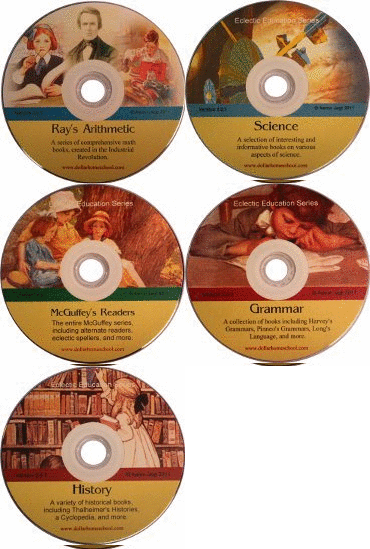
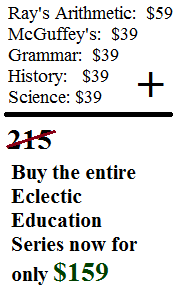
A great resource for quality educational books for your homeschool
is the Eclectic Education Series, a collection of books which provided
Americans with some of the best educations in the world, before John Dewey and the demise of
American education. Click Here to learn more.
|  The Homeschool
Blog
The Homeschool
Blog